

Maitake (Hen of the Woods): A Beginner's Guide
What maitake is, how to recognise it and its lookalikes, where and when it grows in the UK, how to cook it so the edges go crisp, and how to buy it fresh, dried or in capsules.
Quick answer
Maitake (Grifola frondosa), also called hen of the woods, is an edible mushroom that grows as a large, ruffled cluster of grey-brown fan-shaped caps at the base of oak and other hardwood trees, usually from late summer to autumn. Its name is Japanese for "dancing mushroom". It has a rich, earthy, slightly peppery flavour and a meaty texture, and it's best roasted or pan-fried until the frilly edges turn crisp. In the UK you can buy it fresh from some supermarkets and specialist growers, dried from Asian grocers, or as a powder or capsules. If you forage it, be completely sure of the identification, as it has lookalikes.
Key takeaways
- Look for: a rosette of overlapping grey-brown fronds with pores (not gills) underneath, at the foot of an oak.
- Season: mainly August to November in the UK.
- Main lookalike: giant polypore, which is larger, tougher and bruises black when handled.
- Cook it: tear into clusters and roast at a high heat for crispy edges. Don't eat it raw.
- Not chicken of the woods: that's a different, bright orange-yellow mushroom.
Maitake at a glance
- Latin name
- Grifola frondosa
- Other names
- Hen of the woods, ram's head, sheep's head, dancing mushroom
- Type
- Polypore: pores under the caps, no gills
- Grows on
- Base of oak trees and stumps; sometimes beech, chestnut and other hardwoods
- UK season
- Mainly late August to November
- Size
- Clusters often 15–40cm across; can weigh several kilograms
- Flavour
- Earthy, woodsy, peppery, rich umami
- Sold as
- Fresh clusters, dried pieces, powder, capsules
What maitake is
Maitake is a polypore mushroom native to temperate forests across Europe, North America and East Asia. In Japan it has been cooked and traded for centuries, and the story goes that people who found it would dance with joy, which is where the name "dancing mushroom" comes from. Today most maitake sold in shops is cultivated indoors on hardwood sawdust, so it's available all year round.
The English name "hen of the woods" comes from the way a mature cluster looks like a fluffed-up, brown hen sitting at the foot of a tree.
How to identify maitake
- Overall shape: a single large rosette made of dozens of small, overlapping, fan- or spoon-shaped caps, all branching from one thick, white base.
- Cap colour: grey-brown to dark brown on top, often paler at the edges, and slightly wavy.
- Underside: white to cream with tiny pores, like the surface of a sponge. There are no gills.
- Stems: short, white and branching, joining into a solid core.
- Flesh: white, firm and slightly fibrous; it doesn't change colour when cut.
- Where: right at the base of a living or dead oak, or on buried roots close to the trunk.
- Smell: pleasantly mushroomy and earthy when young; older clusters can smell sour.
Lookalikes and mix-ups
| Mushroom | How it differs from maitake | Edible? |
|---|---|---|
| Giant polypore (Meripilus giganteus) | Bigger, thicker, tougher caps; the pores and flesh bruise black when handled | Not poisonous but usually too tough and bitter; not worth eating |
| Chicken of the woods (Laetiporus sulphureus) | Bright orange and sulphur-yellow shelves, often higher up the trunk | Edible when young and well cooked, but disagrees with some people |
| Umbrella polypore (Polyporus umbellatus) | Many small, round, flat caps each on its own central stalk | Edible, but rare in the UK |
| Cauliflower fungus (Sparassis crispa) | Cream, ribbon-like folds like a sponge or brain; grows by pine trees | Edible |
The main thing to remember: if it bruises black, it isn't maitake.
Foraging maitake in the UK
- Be 100% sure: never eat a wild mushroom unless you're certain of its identity. Check with an experienced forager or a local fungi group if in doubt.
- Know the rules: you need permission to forage on private land, and some sites, such as nature reserves and Sites of Special Scientific Interest, don't allow picking at all.
- Pick sustainably: cut the cluster at the base with a knife, leave some behind, and don't damage the tree's roots. The same tree can fruit again in future years.
- Choose young clusters: they're tender and firm. Older ones go tough, soggy or full of insects.
- Clean it at home: forest debris collects in the folds, so tear the cluster apart and brush or rinse briefly.
How to cook maitake
Maitake has a meaty texture and a deep, savoury flavour that gets better with high heat. Always cook it; don't eat it raw.
Crispy roast maitake
- Heat the oven to 220°C (200°C fan).
- Tear the cluster into bite-sized clumps rather than slicing; the ragged edges are what go crisp.
- Toss with 2 tablespoons of oil or melted beef tallow, salt and pepper.
- Spread out on a tray with space between the pieces, and roast for 20–25 minutes, turning once, until the edges are deep brown and crisp.
- Finish with lemon juice, garlic butter or a drizzle of soy sauce.
Pan-fried maitake
Heat a heavy pan until very hot, add a little fat, and lay the pieces in a single layer. Press them down with a spatula or a second pan and leave them undisturbed for 3–4 minutes until golden underneath, then turn and repeat. Add a knob of butter, garlic and thyme for the last minute. High-smoke-point fats such as tallow work well here; see our guide to cooking with beef tallow.
Other ways to use it
- Soups and ramen: add torn pieces for the last 5 minutes.
- Risotto and pasta: fry first, then stir through at the end.
- Tempura: a classic Japanese way to serve it.
- Dried maitake: soak in warm water for 20–30 minutes, then use the soaking liquid as a stock.
Buying maitake: fresh, dried or capsules
| Form | Where to buy | Best for | Look for |
|---|---|---|---|
| Fresh | Some supermarkets, specialist UK growers, farmers' markets | Roasting, frying, centrepiece dishes | Firm, dry, fragrant clusters; no slimy or dark patches |
| Dried | Asian grocers, online | Soups, stocks, stews | Whole pieces, no dust or musty smell |
| Powder | Health shops, online | Stirring into soups, sauces or drinks | Fruiting body named on the label; single ingredient |
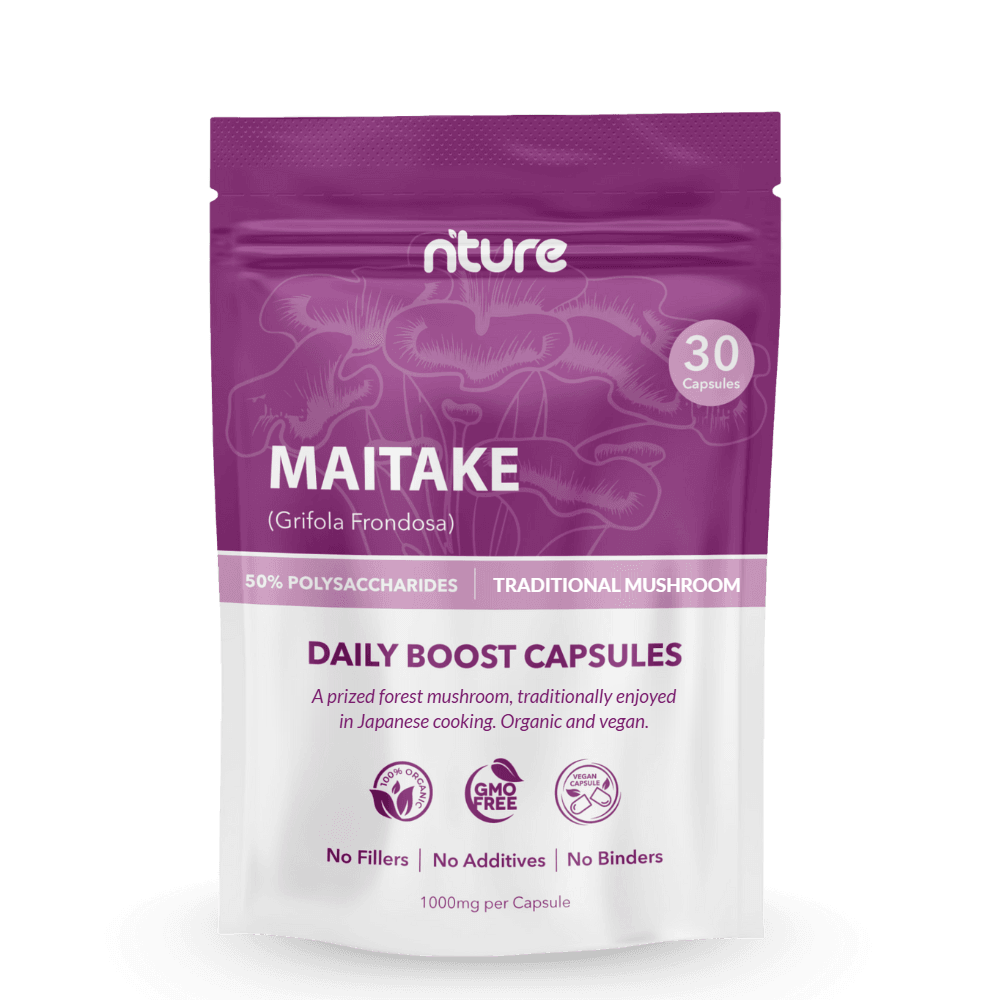
| Capsules | Online, health shops | A convenient daily food supplement | Amount per capsule, fruiting body or extract, vegan shell |
For supplements, check whether the label says fruiting body (the mushroom itself) or mycelium (the root-like network, often grown on grain), and whether it's a whole powder or an extract. A clear label tells you exactly what you're getting.
Storing maitake
- Fresh: in a paper bag in the fridge for 3–5 days. Plastic makes it sweat and go slimy.
- Cooked: in an airtight box in the fridge for up to 3 days, or frozen for up to 3 months.
- Dried: in an airtight jar in a cool, dark cupboard for up to a year.
Who should take care
Cooked maitake is an everyday food for most people. If you're pregnant or breastfeeding, take regular medication (including for diabetes, blood pressure or blood thinning), or are due to have surgery, speak to a GP or pharmacist before taking maitake supplements. As with any mushroom, stop eating it if it disagrees with you.
Maitake FAQs
What is maitake mushroom?
Maitake (Grifola frondosa), also called hen of the woods, is an edible polypore mushroom that grows as a large cluster of grey-brown, fan-shaped caps at the base of oak and other hardwood trees. It's widely cultivated and has a rich, earthy flavour.
Is maitake the same as hen of the woods?
Yes. Maitake is the Japanese name and hen of the woods is the common English name for Grifola frondosa. It's different from chicken of the woods, which is a bright orange-yellow mushroom.
When is maitake season in the UK?
Wild maitake mainly appears from late August to November. Cultivated maitake is available all year round.
What does maitake taste like?
Earthy, woodsy and slightly peppery, with a deep savoury flavour and a meaty texture. Roasting or frying brings out its flavour and makes the edges crisp.
Can you eat maitake raw?
No. Always cook maitake before eating it. Roasting, pan-frying or simmering in soups all work well.
What does maitake look like?
A rosette of many overlapping grey-brown fronds with a white, pored underside and a thick white branching base, usually at the foot of an oak.
What can be mistaken for maitake?
The giant polypore is the most common lookalike. It's larger and tougher, and its flesh and pores bruise black when handled, which maitake doesn't.
Where can I buy maitake in the UK?
Fresh maitake is sold by some supermarkets and specialist mushroom growers. Dried maitake is available from Asian grocers, and powder and capsules are sold online and in health shops.