

Shilajit Resin vs Capsules: What's the Difference?
What shilajit resin is, how it compares with capsules, powder and drops, how to use each, how to check quality and heavy-metal testing, and who should avoid shilajit altogether.
Quick answer
Shilajit is a dark, sticky substance that seeps from rocks in high mountain ranges such as the Himalayas and Altai. Shilajit resin is the purified substance in its traditional sticky form: you scoop a pea-sized amount (about 300–500mg) and dissolve it in warm water or tea. Shilajit capsules contain dried, powdered shilajit or a shilajit extract in a fixed amount, with no taste and no mess. The choice is mostly about convenience, taste and dosing. Whichever you choose, the most important thing is quality: raw shilajit can contain heavy metals, so buy only purified shilajit from a seller who can show independent lab test results.
Key takeaways
- Same source, different form: resin is the traditional paste; capsules hold dried shilajit or an extract.
- Resin: flexible dosing, strong smoky, salty taste, messier, easy to over- or under-measure.
- Capsules: tasteless, pre-measured and portable; check whether they contain whole shilajit or an extract.
- Quality matters most: look for purified shilajit and a certificate of analysis that includes heavy metals.
- Not for everyone: avoid in pregnancy, breastfeeding and childhood, and check with a GP if you take medicines or have a health condition.
Shilajit at a glance
- What it is
- A mineral-rich, tar-like substance formed from decomposed plant material compressed in rock over centuries
- Other names
- Mumijo, mumie, mineral pitch, Asphaltum punjabianum
- Main sources
- Himalayas, Altai, Caucasus and other high mountain ranges
- Main components
- Humic substances (including fulvic acid), dibenzo-alpha-pyrones, minerals
- Typical resin serving
- A pea-sized amount, about 300–500mg
- Typical capsule
- 250–500mg of shilajit or shilajit extract
- Taste
- Smoky, earthy, salty and bitter
- UK health claims
- None authorised for shilajit
What is shilajit resin?
Shilajit forms over hundreds of years as plant matter and microbes decompose under pressure between layers of rock. In warm months it seeps out of cracks in cliffs as a dark, sticky exudate. It has been used in traditional Ayurvedic practice for centuries, and in Central Asia it's known as mumijo.
Raw shilajit is collected by hand and then purified: it's dissolved in water, filtered to remove rock, soil and plant debris, and slowly dried back down to a thick resin. Purified resin is glossy and black to dark brown. It becomes firm and brittle when cold and soft and stretchy when warm.
Its composition varies with where and how it was collected, but it's mainly humic substances such as fulvic and humic acids, along with compounds called dibenzo-alpha-pyrones and a range of minerals.
Resin, capsules, powder and drops
- Resin: the traditional form. Purified shilajit as a thick paste, sold in a jar with a small spoon or spatula.
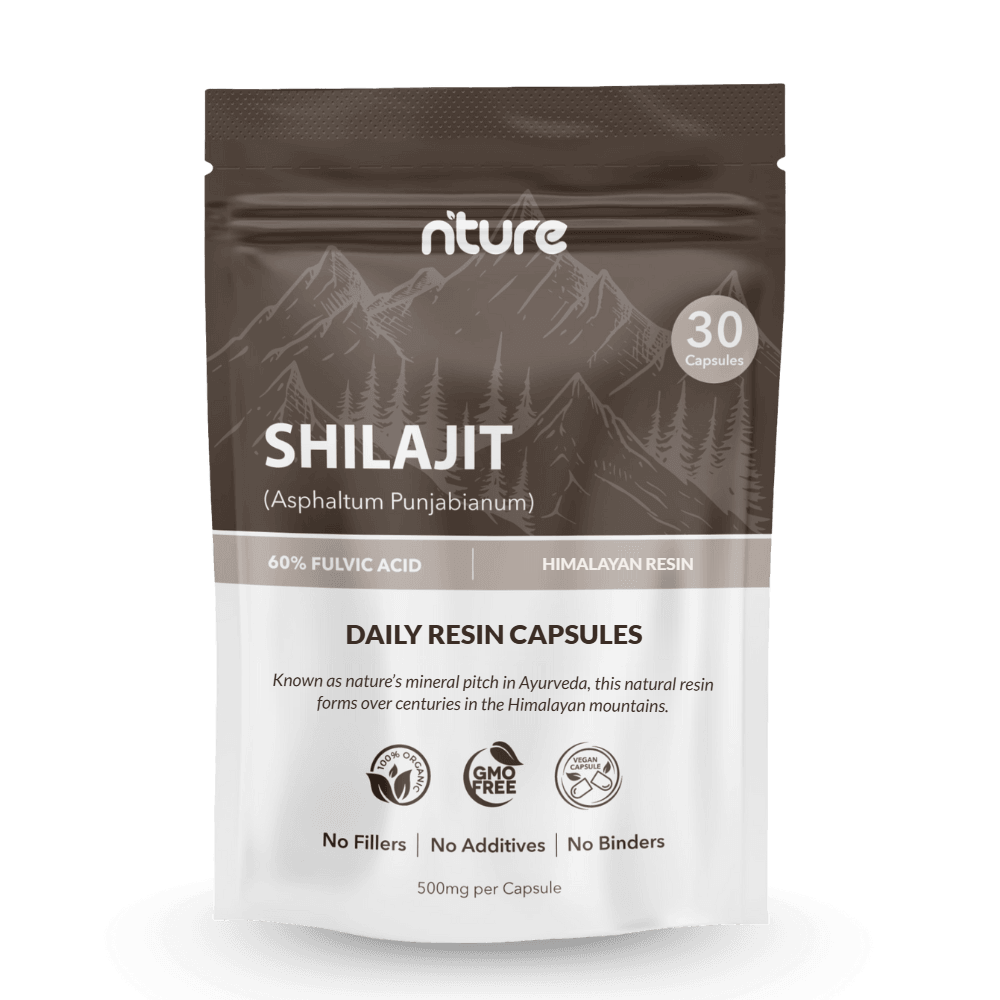
- Capsules: dried, powdered shilajit or a shilajit extract inside a capsule, usually 250–500mg each.
- Powder: dried shilajit ground to a powder, to stir into drinks.
- Drops and liquids: shilajit dissolved in water, sold with a dropper.
- Gummies: shilajit mixed into a sweet, often with other ingredients and sugar.
Resin is often marketed as the "most authentic" form, but any form can be good or poor quality. What matters is purification and independent testing, not the format.
Shilajit resin vs capsules compared
| Shilajit resin | Shilajit capsules | |
|---|---|---|
| Form | Sticky paste in a jar | Dried shilajit or extract in a capsule |
| Taste | Strong: smoky, salty, bitter | None |
| Measuring | By eye, "pea-sized" (about 300–500mg); easy to vary | Fixed amount per capsule |
| How you take it | Dissolved in warm water, tea or milk | Swallowed with water |
| Mess | Sticky; can stain | None |
| Travel | Awkward; softens in heat | Easy |
| Seeing what you buy | You can see and smell the resin | Contents hidden; rely on the label and lab tests |
| Best for | People who like a daily drink ritual and flexible amounts | People who want convenience, consistency and no taste |
Neither form has been shown to be more effective than the other. Some capsules use a concentrated extract rather than whole dried shilajit, so read the label to see exactly what each capsule contains.
How to use shilajit resin
- Measure: scoop a pea-sized amount (about 300–500mg) with the spoon supplied, or follow the label.
- Warm your drink: use warm water, herbal tea or milk. Hot rather than boiling is fine; resin dissolves slowly in cold water.
- Dissolve: stir until there are no lumps. Warming the spoon in the drink first helps the resin slide off.
- Drink: once a day is typical. Many people take it in the morning.
- Store: keep the lid tightly closed, away from heat and sunlight. Resin hardens when cold; warm the jar in your hands to soften it.
The taste is strong. A little honey, lemon or ginger in the drink helps.
How to take shilajit capsules
- Follow the label. Usually 1 capsule a day with water.
- Take with food if you have a sensitive stomach.
- Don't double up with resin or other shilajit products.
- Store them in a cool, dry place out of sunlight and out of reach of children.
How to check shilajit quality
Raw, unpurified shilajit can contain heavy metals such as lead, arsenic, mercury and cadmium, as well as fungi and other contaminants. A 2024 review found contaminants were common in raw shilajit, and testing in 2025 found some finished supplements with higher thallium levels than the raw material. In 2026, a German food lab testing 12 mumijo products also flagged mineral oil residues in several. Quality checks are therefore essential:
- Purified: the label should say the shilajit is purified, ideally explaining how.
- Certificate of analysis (COA): ask for a recent, batch-specific lab report from an independent lab, showing lead, arsenic, mercury and cadmium below safe limits, plus microbial testing.
- Clear origin: region of harvest and where it was processed and packed.
- Clear contents: resin weight, or mg per capsule, and whether it's whole shilajit or an extract.
- Nothing hidden: no added sugar, fillers or other herbs unless clearly listed.
- Sensible marketing: be wary of products promising big health results. No health claims are authorised for shilajit in the UK.
"Lab tested" on a label isn't enough on its own. A real certificate names the lab, the batch and the results.
Do home "purity tests" for shilajit work?
You'll see videos showing shilajit "tests": burning it, stretching it, dissolving it in water, or watching it harden in the fridge. These show how resin behaves, and a fake made from tar or added ingredients may fail some of them. But none of them can tell you whether shilajit contains heavy metals, which is the main safety concern. Only a laboratory analysis can do that.
Who should avoid shilajit
- Pregnant or breastfeeding women, and people trying to conceive.
- Children and teenagers.
- People with haemochromatosis (iron overload) or other blood conditions such as sickle cell disease or thalassaemia.
- People with heart, liver or kidney conditions, or gout.
- Anyone taking medication, particularly for blood sugar, blood pressure, thyroid or blood clotting.
- Anyone with an operation coming up.
Reported side effects include stomach upset, nausea, headache, dizziness and allergic reactions. Stop and seek advice if you feel unwell.
Shilajit and UK rules
In Europe, shilajit (listed as mumijo or Asphaltum punjabianum) is generally accepted only as a food supplement, not as an ordinary food or drink ingredient. Fulvic acid on its own is not an authorised food ingredient, so treat headline "fulvic acid %" figures as marketing rather than a quality guarantee.
No health claims are authorised for shilajit in the UK. Research is limited to small, short studies, and claims about energy, hormones or performance aren't backed by an authorised claim. Shilajit should be bought as a supplement from a reputable UK seller, used as the label directs, and never as a substitute for medical advice.
Shilajit resin FAQs
Is shilajit resin better than capsules?
Not necessarily. Resin is the traditional form and lets you vary the amount; capsules are tasteless, pre-measured and convenient. Quality, purification and independent testing matter far more than the format.
How much shilajit resin should I take?
Follow the label. A typical serving is a pea-sized amount, about 300–500mg, dissolved in warm water or tea once a day.
What does shilajit resin do?
Shilajit has a long history in traditional practice, but there are no authorised health claims for it in the UK, and research is limited to small, short studies. It's sold as a food supplement.
What are the side effects of shilajit resin?
Reported side effects include stomach upset, nausea, headache, dizziness and allergic reactions. Poor-quality or unpurified shilajit may also contain heavy metals, so buy only lab-tested, purified products.
What happens if I take shilajit every day?
Products are designed for daily use at the label serving. Long-term safety data is limited, so stick to the stated amount, choose tested products, and check with a GP if you have a health condition or take medication.
How can I tell if shilajit is real?
Home tests like burning or stretching show how resin behaves but can't detect heavy metals. Ask for a batch-specific certificate of analysis from an independent lab.
Does shilajit taste bad?
It's strong: smoky, earthy, salty and bitter. Dissolving it in tea with honey or lemon helps, or choose capsules to avoid the taste.
How should I store shilajit resin?
In its sealed jar, in a cool, dry place away from sunlight. It hardens when cold and softens when warm; both are normal.