

What Is Raw Honey? Raw vs Regular Honey
"Raw" is one of the most common words on a honey jar, but it has no legal definition in the UK. Here's what it usually means, how raw honey differs from supermarket honey, why it sets solid, how to read a label, and how to store and use it.
Quick answer
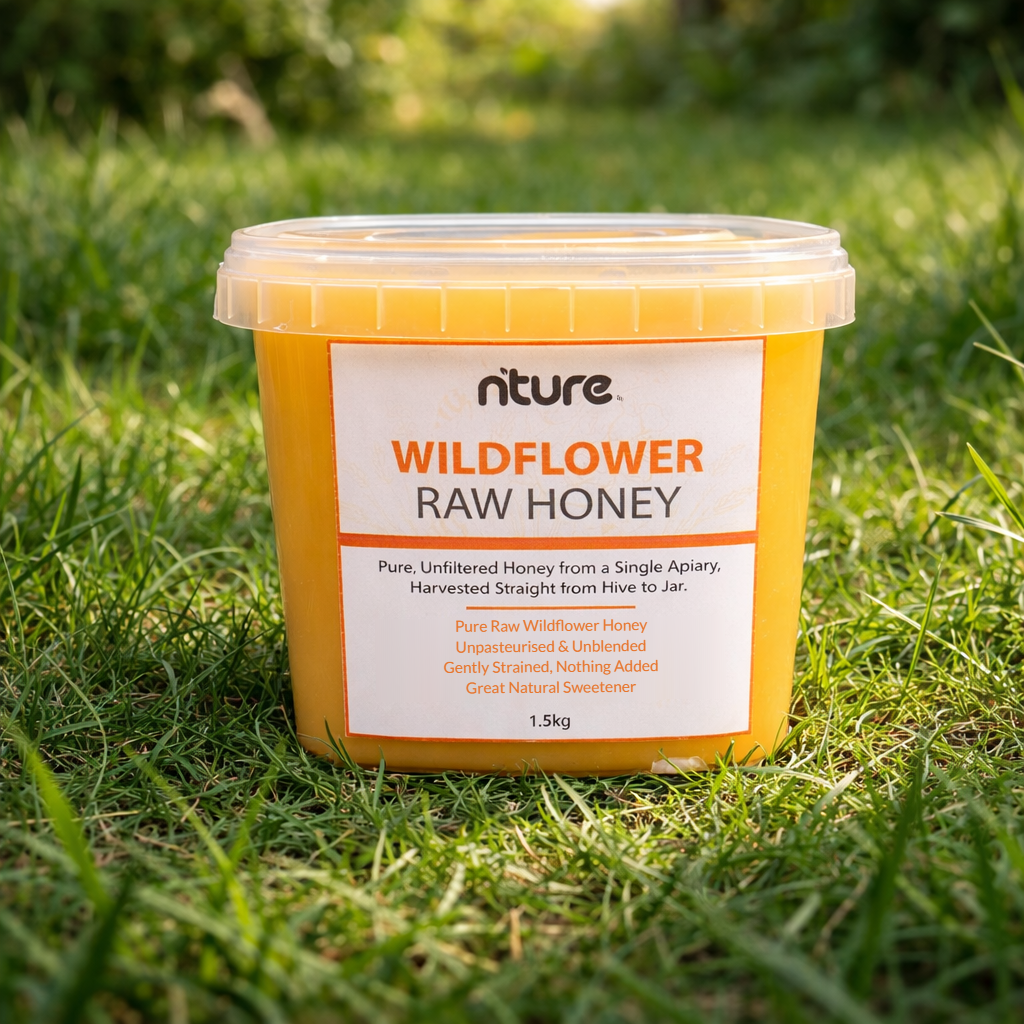
Raw honey is honey that goes from the hive to the jar with as little processing as possible. It's usually only strained to remove bits of wax and bee, and it isn't heated much above the warmth of the hive or finely filtered, so it keeps its natural pollen, aroma and texture. Regular supermarket honey is often blended from several sources, heated to keep it runny for longer and finely filtered for a clear look. There's no legal definition of "raw" in the UK, so check the label for details such as "unpasteurised", "unblended" and a named origin.
Key takeaways
- "Raw" isn't regulated: it's a description used by producers, not a legal category.
- The big differences: heat, filtration and blending.
- Crystallising is normal: raw honey often sets faster, and it isn't a sign it's gone off.
- Taste varies: flavour and colour depend on which flowers the bees visited.
- Never for babies: no honey of any kind for children under 12 months.
Raw vs regular honey at a glance
| Raw honey | Regular supermarket honey | |
|---|---|---|
| Heating | Not heated beyond hive-like temperatures | Often heated to make bottling easier and slow crystallisation |
| Filtering | Strained through a coarse mesh; pollen stays in | Often finely filtered, which removes most pollen |
| Source | Often a single apiary, region or flower | Often a blend from several countries |
| Appearance | Can be cloudy or opaque, with tiny particles | Clear and glossy |
| Texture over time | Usually crystallises within weeks or months | Stays runny for longer |
| Flavour | Distinctive; varies with season and flowers | Mild and consistent from jar to jar |
| Price | Higher | Lower |
What "raw" means
UK honey law sets out what can be sold as honey and how it must be labelled, including categories such as comb honey, chunk honey, extracted honey and filtered honey. It doesn't define "raw". In practice, producers use "raw" to mean honey that has been:
- Extracted from the comb, usually by spinning the frames in a centrifuge.
- Strained through a coarse mesh to catch wax, propolis and bee parts.
- Left unheated, or only warmed gently, typically to no more than the temperature inside a hive (around 35–40°C).
- Not finely filtered, so natural pollen grains remain.
- Jarred without anything added.
Because the term isn't regulated, two jars labelled "raw" can be processed slightly differently. Look for extra details on the label, which are covered below.
How regular honey is processed
Most large-scale honey is processed so it looks and pours the same in every jar. Common steps include:
- Blending: honeys from many beekeepers, and often several countries, are mixed for a consistent colour and taste.
- Heating: the honey is warmed so it flows easily through pipes and filters, and sometimes heated further to dissolve sugar crystals and delay setting.
- Fine filtration: pressure filtering removes tiny particles, including most pollen, for a crystal-clear finish.
- Bottling: the honey is packed warm, ready to sit on the shelf as a runny liquid for months.
None of this makes regular honey unsafe. It simply changes its texture, appearance and, often, its flavour.
Why raw honey crystallises
Honey is a supersaturated sugar solution, mostly fructose and glucose. Over time the glucose comes out of solution and forms crystals, turning the honey thick, pale and spreadable. This is called crystallising, setting or granulating, and it's completely natural.
- Raw honey sets sooner because its pollen grains and tiny particles give crystals somewhere to start forming.
- The flowers matter: honey high in glucose, such as oilseed rape, can set within days, while acacia honey can stay runny for a year or more.
- Temperature matters: honey crystallises fastest at around 10–15°C, so a cool kitchen or the fridge speeds it up.
- To make it runny again: stand the closed jar in a bowl of warm (not boiling) water and stir now and then until the crystals dissolve. Avoid the microwave, which overheats it unevenly.
Raw honey types and textures
- Wildflower (polyfloral): made from many different flowers, so the colour and flavour change with the season and location.
- Monofloral: mostly from one type of flower, such as heather, clover, lavender, acacia or manuka, each with its own character.
- Comb honey: sold still sealed in the beeswax comb, the least processed form of all.
- Set or creamed honey: crystallised honey, sometimes stirred to make the crystals fine and smooth.
- Runny honey: liquid honey, which can be raw if it hasn't been heated or finely filtered.
How to read a honey label
- Look for detail: words such as "unpasteurised", "unheated", "cold-extracted", "unblended" and "gently strained" tell you more than "raw" alone.
- Check the origin: UK labels must state where the honey was harvested. A single named country, region or apiary usually means less blending.
- Check the ingredients: honey should be the only ingredient. Anything with added syrups can't legally be sold simply as honey.
- Know the myths: home "tests" such as dissolving honey in water, setting it alight or watching how it drips aren't reliable ways to judge purity or rawness.
- Buy from a source you trust: honey is one of the foods most often targeted by fraud, with sugar syrups added to imported honey. Traceable, single-source honey reduces that risk.
Nutrition: is raw honey different?
Raw and regular honey are nutritionally very similar. Both are around 80% sugars (mainly fructose and glucose) and about 17–18% water, with roughly 300–330 kcal per 100g, or about 60 kcal in a tablespoon. Raw honey also contains small amounts of pollen and the natural compounds that give each honey its colour and aroma, which is why raw honeys from different flowers taste so different. Whichever you choose, honey is a free sugar, so the NHS advice to limit free sugars applies.
How to use and store raw honey
- Drizzle: over porridge, yoghurt, granola, toast, pancakes or cheese.
- Stir in: add to tea or warm (not boiling) drinks once they've cooled slightly, to keep the flavour.
- Dress and glaze: whisk into salad dressings, marinades and glazes for roast vegetables or meat.
- Bake: use in flapjacks, cakes and breads. Baking heats it, so save your best raw honey for no-cook uses.
- Store: keep it sealed in a cool, dry cupboard away from direct sunlight. It doesn't need refrigerating, and the fridge makes it set faster. Always use a clean, dry spoon, as water can make it ferment.
Who should take care
- Babies under 12 months: never give honey of any kind, raw or regular, to babies under one year old. The NHS advises this because honey can contain bacteria that cause infant botulism.
- Pollen or bee-product allergies: if you're allergic to pollen or bee products, check with your GP before trying raw honey, as it contains pollen.
- Sugar intake: honey counts as free sugar, so enjoy it as part of a balanced diet.
Raw honey FAQs
What is raw honey?
Raw honey is honey that has been extracted from the comb and strained, but not heated beyond hive-like temperatures or finely filtered. It keeps its natural pollen, aroma and texture.
What is the difference between raw and regular honey?
Regular supermarket honey is often blended from several sources, heated and finely filtered so it stays clear and runny. Raw honey is usually single-source, unheated and only coarsely strained, so it's often cloudier and crystallises sooner.
Is raw honey legally defined in the UK?
No. UK honey law defines honey and categories such as comb, extracted and filtered honey, but not raw. Look for extra label details such as unpasteurised, unblended and the country or apiary of origin.
Why has my raw honey gone solid?
It has crystallised, which is natural. The glucose in honey forms crystals over time, and raw honey sets sooner because its pollen helps crystals form. Warm the closed jar in warm water to make it runny again.
Does raw honey go off?
Stored sealed in a cool, dry place, honey keeps for a very long time. Use it by the best-before date for the best flavour, and keep water out of the jar, as watery honey can ferment.
Should raw honey be kept in the fridge?
No. Keep it in a cool, dry cupboard. The fridge doesn't help it keep and makes it crystallise faster.
Can babies have raw honey?
No. The NHS advises not giving honey of any kind, raw or regular, to babies under 12 months because of the risk of infant botulism.
Is raw honey the same as organic honey?
No. Raw describes how the honey is processed, while organic is a certification about how and where the bees forage and how the hives are managed. A honey can be raw, organic, both or neither.