

Himalayan Shilajit: Where It Comes From and How It's Purified
Where Himalayan shilajit is found, how it forms in the rock over centuries, how it's collected, the traditional and modern ways it's purified, and what lab testing should show before you buy.
Quick answer
Himalayan shilajit is a dark, tar-like substance that seeps out of cracks in high rock faces in the Himalayas, mainly in Nepal, northern India, Pakistan and Tibet. It forms over hundreds of years as plant and microbial matter breaks down and is compressed in the rock. Collectors scrape it from cliffs by hand in the warmer months. Raw shilajit contains rock, soil and possible contaminants, so it's purified by dissolving it in water, filtering it repeatedly and slowly drying it back to a resin. The most important check for any shilajit is an independent lab report showing heavy metals and microbes are within safe limits.
Key takeaways
- Where: high rock faces in the Himalayas; similar material also comes from the Altai, Pamir and Caucasus.
- How it forms: slowly, over centuries, from decomposed plant matter in rock crevices.
- Collection: by hand, seasonally, from limited deposits.
- Purification: dissolving, filtering and gentle drying; raw shilajit isn't fit to use as it is.
- Proof of quality: a batch-specific certificate of analysis, not the word "Himalayan" on the label.
Himalayan shilajit at a glance
- What it is
- An organic-mineral exudate from high-altitude rock
- Himalayan sources
- Nepal, Himachal Pradesh and Uttarakhand (India), Gilgit-Baltistan (Pakistan), Tibet
- Other sources
- Altai (Russia, Mongolia), Pamir (Tajikistan), Caucasus, Iran, Afghanistan
- Found in
- Crevices and caves in limestone and other sedimentary rock, at high altitude
- Main components
- Humic substances (roughly 60–80%), including fulvic acid; minerals; dibenzo-alpha-pyrones
- Collected
- By hand, mostly in warmer months when it softens and seeps out
- Sold as
- Purified resin, powder, capsules or drops
- UK status
- Sold as a food supplement; no authorised health claims
Where Himalayan shilajit comes from
Shilajit is found in high mountain ranges across Asia, but "Himalayan shilajit" refers to material collected in the Himalayan range itself. The main sources are:
- Nepal: the best-known source, especially remote mid- and high-mountain districts.
- Northern India: Himachal Pradesh and Uttarakhand.
- Pakistan: Gilgit-Baltistan and the neighbouring Karakoram.
- Tibet: the Tibetan Plateau, where it's been used in traditional Tibetan practice.
Similar material, often called mumijo, comes from the Altai mountains of Russia and Mongolia, the Pamir in Tajikistan and the Caucasus. Composition varies from region to region and even between rock faces in the same valley, so "Himalayan" tells you where it came from, not how good it is. Purification and testing matter more than the mountain range.
How shilajit forms
Shilajit builds up over hundreds of years in sheltered cracks and small caves in limestone and other sedimentary rock. Scientists still debate exactly how it forms, and different deposits may form in different ways. The main explanations are:
- Plant humification: plant material such as mosses, lichens and resinous plants decomposes and is slowly transformed into humus-like compounds, compressed between layers of rock.
- Microbial action: microorganisms break down plant remains and other organic matter over long periods.
- Mineral interaction: the organic material binds with minerals leached from the surrounding rock.
The result is a mix of humic substances (including humic and fulvic acids), small aromatic compounds called dibenzo-alpha-pyrones, and minerals such as calcium, magnesium, potassium and iron, along with traces of other elements, some of which are unwanted.
How Himalayan shilajit is collected
- When: in the warmer months, when the sun softens shilajit and it seeps out of rock cracks as a dark, sticky exudate.
- Where: on high, often remote cliffs and rock faces, typically reached on foot.
- How: collectors chip or scrape the raw material from the rock by hand, along with pieces of stone and soil.
- How much: deposits are small and limited, and they can take many years to replenish. That's one reason good shilajit is relatively expensive.
Raw shilajit at this stage looks like dark, crumbly rock mixed with tar. It isn't suitable for use until it's been purified.
Shilajit's names around the world
| Name | Where it's used |
|---|---|
| Shilajit, shilajatu | India, Nepal (Sanskrit roots, often translated as "rock" or "mountain" pitch) |
| Mumijo, mumie, mumiyo | Russia, Central Asia, Europe |
| Brag-shun | Tibet and Mongolia |
| Mineral pitch | English |
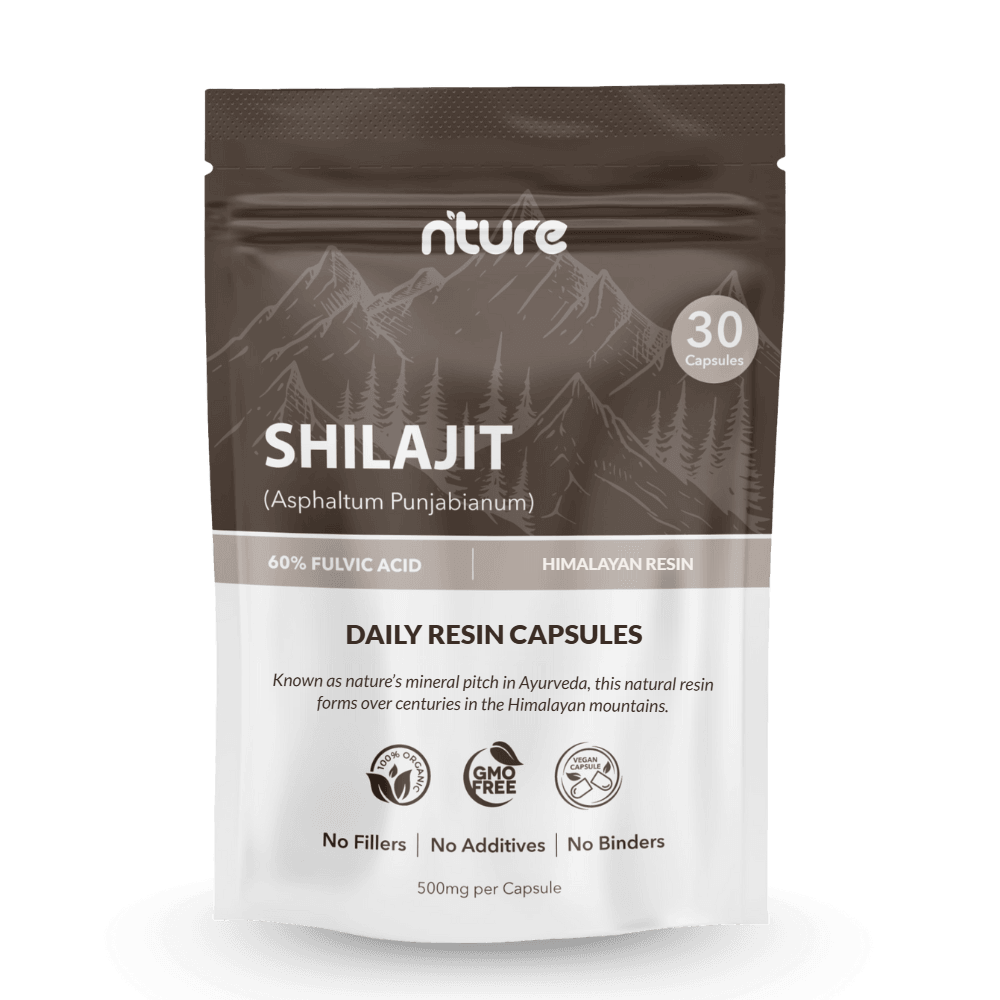
| Asphaltum punjabianum | Botanical-style name used on supplement labels |
How shilajit is purified
Traditional purification (shodhana)
Ayurvedic texts describe a purification step called shodhana. Raw shilajit is soaked and dissolved in water, sometimes with herbal decoctions such as triphala, then filtered through cloth and dried in the sun. The idea is to separate the useful dissolved material from stone, soil and other impurities.
Modern purification
- Sorting: the raw material is cleaned of loose stones and debris.
- Dissolving: it's soaked in clean water, often for days, so the soluble shilajit dissolves out of the rock.
- Settling: heavy particles sink, and the dark liquid is drawn off.
- Filtering: the liquid passes through several stages of increasingly fine filters to remove sand, silt and microbes.
- Concentrating: water is slowly evaporated, either in the sun (sometimes called sun-dried or "Surya Tapi") or with gentle, low-temperature heat, until a thick resin remains.
- Testing: each batch should be lab-tested before it's packed as resin, or dried and powdered for capsules.
Some capsule products go further and make a standardised extract, concentrating particular components. The label should say whether a product contains whole purified shilajit or an extract.
Raw vs purified shilajit
| Raw shilajit | Purified shilajit | |
|---|---|---|
| Appearance | Crumbly, rock-like, mixed with stone and soil | Glossy, smooth black-brown resin or fine powder |
| Impurities | Rock, sand, plant debris, possible microbes | Removed by dissolving and filtering |
| Heavy metals | May be present at unsafe levels | Should be tested and within limits |
| Suitable to use? | No | Yes, if independently tested |
What lab testing should show
Because shilajit comes from rock, contamination is the main concern. Ask for a recent, batch-specific certificate of analysis (COA) from an independent laboratory. It should include:
- Heavy metals: lead, arsenic, cadmium and mercury, all within UK and EU limits for food supplements.
- Microbiology: total bacteria, yeasts and moulds, and pathogens such as E. coli and Salmonella.
- Identity: confirmation that the product is shilajit, not a lookalike.
- Batch details: the lab's name, the batch number and the date.
A headline "fulvic acid %" isn't a safety test, and fulvic acid isn't an authorised food ingredient on its own. Our guide to shilajit resin vs capsules has more on choosing between forms and why home "purity tests" can't detect heavy metals.
Fakes and adulteration
Real shilajit deposits are limited, so cheaper lookalikes exist. These can include mineral pitch or tar, mountain wax, fossilised resins, or genuine shilajit bulked out with other ingredients. Warning signs include:
- A very low price for a large amount.
- No named origin, no batch number and no lab report.
- An ingredient list with anything other than shilajit, unless clearly declared.
- Big health promises on the label or website.
Who should avoid shilajit, and UK rules
Shilajit isn't suitable during pregnancy or breastfeeding, or for children. People with haemochromatosis (iron overload), sickle cell disease or thalassaemia, heart, liver or kidney conditions, or who take regular medication should speak to a GP or pharmacist first.
In the UK and Europe, shilajit is generally accepted only as a food supplement, and no health claims are authorised for it. Use it as the label directs, and don't use it in place of medical advice.
Himalayan shilajit FAQs
What is Himalayan shilajit?
A dark, tar-like substance that seeps from high rock faces in the Himalayas. It forms over centuries from decomposed plant matter and minerals, and is collected by hand, then purified.
Where does Himalayan shilajit come from?
Mainly Nepal, the Indian states of Himachal Pradesh and Uttarakhand, Gilgit-Baltistan in Pakistan, and Tibet. Similar material also comes from the Altai, Pamir and Caucasus mountains.
Is Himalayan shilajit better than Altai shilajit?
Not necessarily. Composition varies by deposit, and quality depends far more on purification and testing than on the mountain range. Choose a product with a batch-specific lab report.
How is shilajit purified?
Raw shilajit is dissolved in water, left to settle, filtered through progressively finer filters and slowly dried back to a resin, either in the sun or with gentle heat. Each batch should then be lab-tested.
Is raw shilajit safe?
No. Raw shilajit contains rock and soil and may contain heavy metals and microbes. Only use purified shilajit that has been independently tested.
Why is shilajit so expensive?
Deposits are small and hard to reach, collection is done by hand in remote mountains, and proper purification and lab testing take time.
Who should avoid taking shilajit?
Pregnant or breastfeeding women, children, people with iron overload or blood disorders, people with heart, liver or kidney conditions, and anyone on regular medication should get medical advice first.
What is shilajit called in other languages?
It's known as mumijo or mumie in Russia and Central Asia, brag-shun in Tibet and Mongolia, and mineral pitch in English. Supplement labels may list it as Asphaltum punjabianum.